How do you recreate a motorcycle first seen in 1901 when you have no surviving examples, no technical drawings and just a handful of period photos? Answer: A combination of the facts you do have, period knowledge and some good guesses, that’s how and that’s just what Royal Enfield has done with its Project Origin.
Now, you may have seen this story before but it was news to me when I stumbled across it. In 2021, Royal Enfield wanted to celebrate its 120th year of producing motorcycles but realised it did not have a single example of its first motorcycle, the 1901 motor-bicycle launched that year at the Stanley Cycle Show.
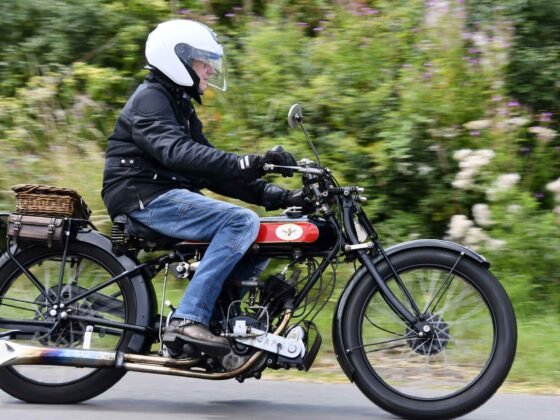
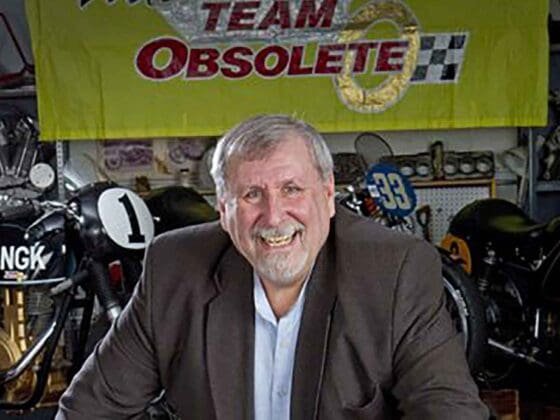
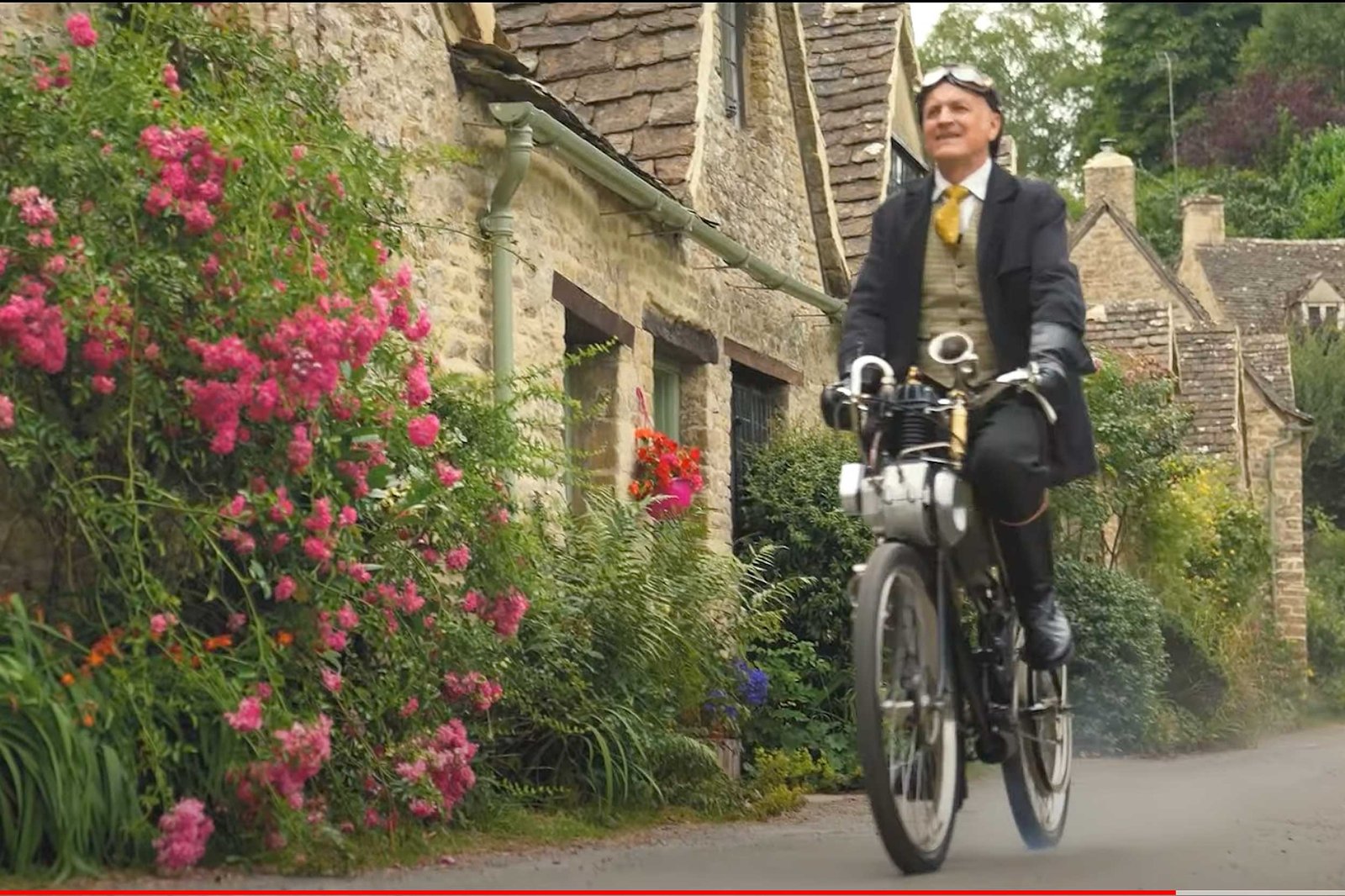
That very first prototype Royal Enfield motor-bicycle was developed by Frenchman Jules Gobiet working with Royal Enfield’s co-founder and chief designer, Bob Walker Smith. The challenge to build a replica was made to the Royal Enfield design and engineering teams by Gordon May, Royal Enfield’s in-house historian, pictured here and in the video riding the completed motor-bicycle.
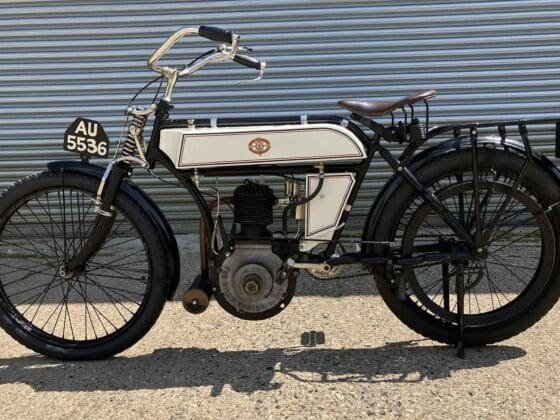
It was clear from the outset that the mechanics, engineering and ergonomics of the original Royal Enfield motor-bicycle was worlds’ apart from modern motorcycles. One of the most obvious differences was in the mounting position of the 1.75hp engine clamped onto the steering head above the front wheel, which in turn drove the rear wheel via a long crossed-over rawhide belt.
Gobiet hoped that powering the rear wheel would reduce the side-slip commonly associated with front wheel driven Werner motor-bicycles. Unlike most other engines, the Royal Enfield’ crankcase was horizontally split to avoid oil dripping onto the front wheel from leaky vertically split crankcases.
A Longuemare spray carburettor was situated on the side of the petrol tank some distance lower than the level of the engine’s cylinder head, a secondary feed was taken off the exhaust and passed around the carburettor mixing chamber to warm the fuel and prevent icing. Lubrication was total loss, the rider squirting a charge of oil into the crankcase via a hand oil pump located on the left side of the cylinder. This would burn off after 10 to 15 miles at which point another shot of lubricant was required.
The cylinder head housed a mechanical exhaust valve and an automatic inlet valve. The inlet valve was held closed by a weak spring and opened by vacuum. As the piston travelled down the cylinder, the inlet valve was sucked open allowing a charge of air-fuel mixture in.
A contact breaker assembly on the timing side axle triggered a trembler coil, which sent a rapid succession of pulses to the spark plug. This resulted in a good burn despite running at very low revs.
Starting the machine required pedal power, and then once the engine fired, the carburettor was opened from tickover to full-on position by a hand lever located on the right side of the petrol tank.

There was no throttle – speed was modulated by a valve lifter opened by a handlebar lever. To slow, the rider applied the valve-lifter. This opened the exhaust valve and as there was now no vacuum in the cylinder, the automatic inlet valve stayed shut and no air-fuel mixture entered the cylinder head. As soon as the rider closed the exhaust valve, the inlet valve opened and the engine fired.
The front wheel had a band brake that was applied by a Bowden lever and cable arrangement operated by the rider’s left hand. The rear wheel also had a band brake but this was operated by back pedalling. The saddle was a leather Lycette La Grande and the 26in wheels were shod with Clipper 2 x 2in tyres. It cost exactly £50 which is the equivalent of £4000 in today’s money.
One of the most complex and intricate elements lay in the construction of the folded brass tank, masterfully handcrafted from a single sheet of brass – folded, shaped, hammered and soldered using age-old tools and techniques now almost forgotten to modern manufacturing.
The tubular frame of the motor-bicycle was expertly brass-braised by the team at Harris Performance as well as hand machined brass levers and switches.
The engine was completely built from scratch, and with no reference blueprints or technical diagrams the team studied the few photographs and illustrations available from 1901 to develop CAD designs for each component part which were then either individually hand-cast or machined from solid.
In addition, the team hand turned the wooden handles, manufactured the front and back band brakes, and had the carburettor built from scratch.
The turn of the century period original parts that were sourced – the paraffin lamp, the horn, the leather saddle, the wheels – were all reconditioned and nickel plated to give the impression that the finished ‘Project Origin’ motor-bicycle had just been unveiled to the public for the very first time at the 1901 Stanley Cycle Show.